What Gets Lost in Efficiency
Lately the work hasn’t just been about looking at images—it’s been about listening to what those images say back. Not in a quick “pick a favorite to post” way, but in a slower way: what actually mattered this year versus what only felt important in the moment.
Sitting with that on my own only goes so far. There’s a limit to what can be seen from inside my own perspective. The other half is asking the people who actually used the work—the architects and builders who hired me, who needed those photographs for something specific, who know if they did their job or not.
So that’s what I’ve been doing.
Listening to the people who use the work
These aren’t sales calls. I’m not pitching new projects or chasing invoices. I’m reaching out to ask a few simple, uncomfortable questions: How did that go? What worked? What didn’t? Was there something you needed that I didn’t quite deliver?
The answers have been revealing.
Some of the images I thought were strongest didn’t serve their needs the way I assumed they would. A detail I barely noticed turned out to matter more than I realized. The way I communicated during a shoot could have been clearer. None of that is fun to hear—but it’s exactly what I needed to hear.
One pattern keeps showing up in both their feedback and my own review: I’ve gotten very efficient.
When efficiency starts to cost something
On paper, efficiency sounds perfect. Move quickly. Get through the list. Hit every angle. Stay on schedule. That kind of speed is great for getting work done. But it raises a harder question: what am I moving past while I’m being so efficient?
Client projects still need that efficiency—there are timelines, shot lists, people waiting on results. The problem is that efficiency has crept into everything, even the parts of photography that don’t need to move that fast. I’ve gotten so used to going from one task to the next that I forgot how to simply stand still and look.
This winter needed a constraint. Something that wouldn’t let those habits run on autopilot. Not on client time, but on my own.
Why film became the constraint
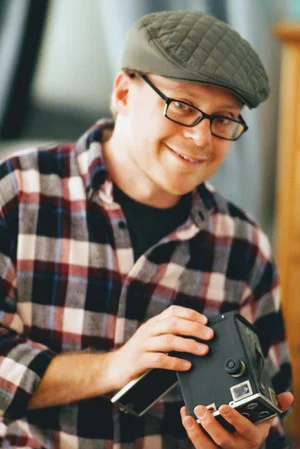
The constraint I landed on was simple: film.
Not for clients. Not even for portfolio pieces. Just for me. To see what happens when I can’t rely on all that efficiency to carry me through.
Film changes the math. There are a limited number of frames on a roll. Once the shutter is pressed, that frame is gone. No checking the back of the camera. No shooting five slight variations and deciding later. You either commit to the frame or you don’t.
People have talked about this for years—the way film slows you down, the intentionality, the craft. All of that is true. But what stands out right now isn’t the medium itself; it’s the questions it forces.
Do I actually see this shot, or am I photographing it because it feels like something I “should” shoot? Is this composition working, or am I planning to fix it in post? Am I pressing the shutter because the frame matters, or because I know I can always shoot another one if I’m wrong?
With film, those questions have to be answered before pressing the shutter. Not later in the edit. Right there, in the moment.
Seeing what’s been walked past
One thing has become obvious: I’ve been overshooting on digital. Not recklessly, but enough that I’ve been leaning on volume to land on the right image instead of trusting my eye to find it sooner. It works, technically. But it doesn’t feel like it’s making me better.
Film doesn’t allow that. The frames run out too quickly. So you slow down. You look longer. You either commit or you move on.
For the past few weeks, I’ve been walking with a film camera. Not on assignments—just walking. Around my neighborhood. Through nearby towns. Past places I’ve driven by a hundred times without stopping.
There’s an industrial building about ten minutes from my house. I’ve passed it several times a week for the last year. I always thought of it as nothing special. But when I finally stopped and actually looked, the way the afternoon light hits the brick, the texture of the paint, the rhythm of the windows—it’s good. I just never saw it because efficiency kept me moving past.
That’s what efficiency does: it gets you where you’re going, but you can miss everything in between. Not just buildings, but details—the way materials weather, how light moves through a space, the small decisions someone made when they built something that only show up if you’re paying attention.
Trading speed for attention
On client shoots, efficiency still matters. There’s a schedule. A list. Responsibilities. That’s part of the job. The shift is realizing I’ve been carrying that same pace into every other part of photography, even when there’s no deadline at all. Film is forcing that to change.
Film isn’t magic or automatically better. What it does is make efficiency expensive. Every frame costs something. So you pause. You look longer. You ask if this scene is actually worth photographing, or if you’re just lifting the camera out of habit.
The more time is spent working this way, the more things start to appear that used to vanish in the blur. Which leads to a harder question: if this much was being missed on casual walks, what might be getting missed on actual projects while moving quickly to finish the shot list?
There isn’t a clean answer yet. But it’s starting to feel like efficiency shouldn’t always be the goal. Sometimes the goal is just seeing clearly—and that takes time.
So this winter is an experiment in shifting priorities: what happens when the aim isn’t speed, but attention? What shows up when the default isn’t “move on,” but “stay a little longer and look again?” The hope is that this mindset carries over. That regular time with film changes the way client work is approached with a digital camera.
It’s early. But already, slowing down has made one thing obvious: when you actually stop and look, there’s a lot you’ve been missing.